Thursday, October 6, 2022

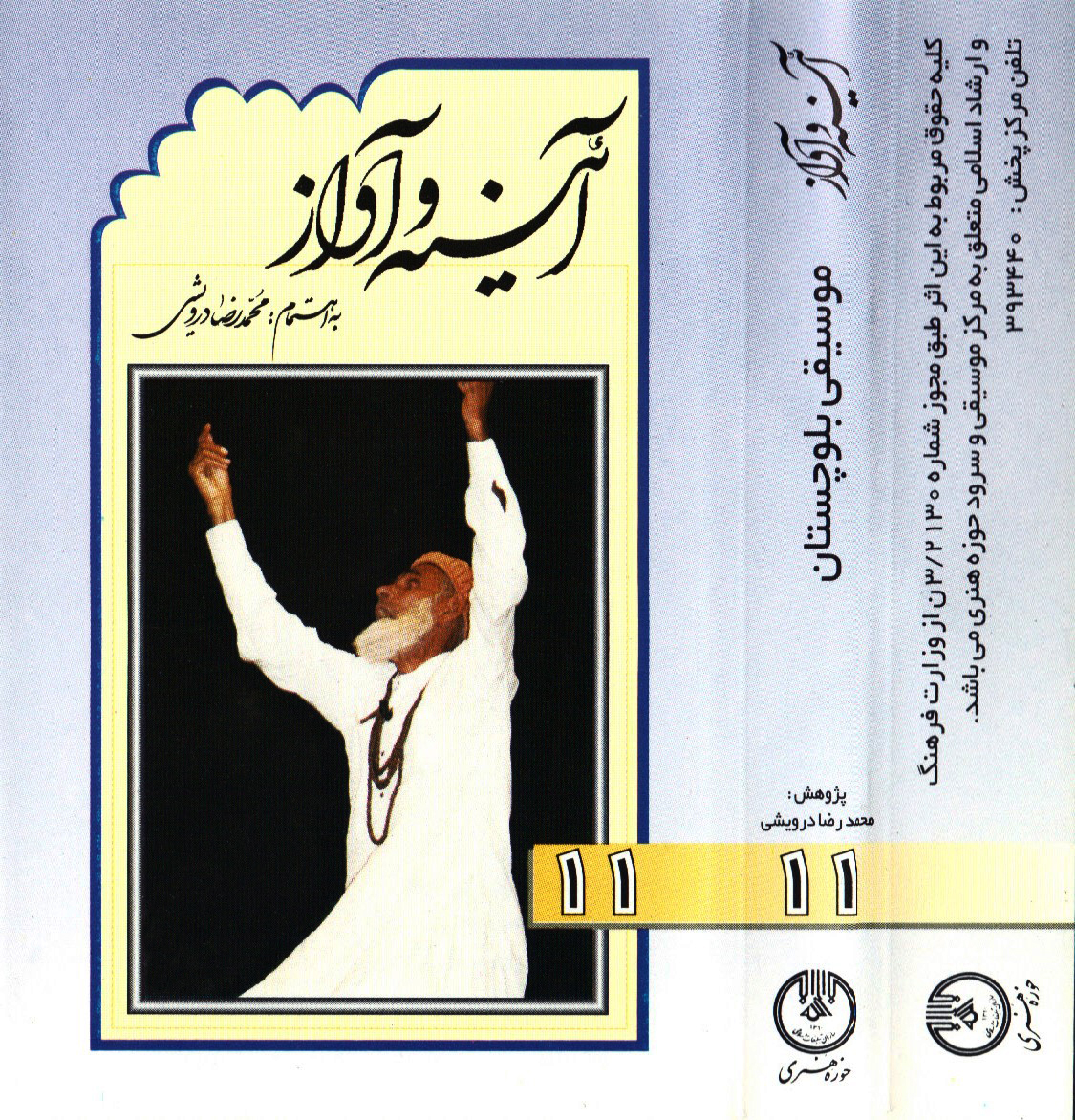
IRAN Music from Baluchestan – Mirror and Song – Cassette 11

IRAN 

Music from Baluchestan – Mirror and Song – Cassette 11 – from a collection of 28 cassettes of regional and religious music from Iran, recorded in 1994

#Iran #Baluchestan #Balochistan #Baluchistan # Mirror and Song # Dhikrs # Gwati #Guati #Qalandari #ceremony #healing #ritual #tambourak # ghichak # sorud ## cassette #traditional music #world music #Tawfiq # oriental-traditional-music.blogspot #MusicRepublic 

Originally posted by Tawfiq, who passed away in April 2019, on his great blog oriental-traditional-music.blogspot.com on September 24, 2016.


 *********


Side A:

Music from Chabahar - Baluchestan

Dhikrs of Gwati ceremonies

Shahmir Baluch Maldari (Vocal & Tambourak & Leader of the ceremony)

Ali Mohammad Baluch (Ghichak (Sorud))

Eyduk Razmi (Tambourak)

Chalokparvar (Vocal - Qasidah)


Side B:

Music Gwati from Beluchestan

Ali Mohammad Beluch (Sorud (Ghichak))

 Eyduk Razmi (Tambourak)


"Music of Guati ceremonies or Qalandari-Guâti music. Guati (or Qalandari-guati) music is specific to the ceremonies of healing the person who is possessed by a supernatural being, and shows symptoms of sickness. Baluchi people interpret the healing process as follows: a person (most of the time a woman) becomes sick and all the efforts of the traditional healer and mollah to cure her are in vain. Patient's relatives, after trying all the possible ways of treatment - and becoming disappointed - take her to a spirit expert (or khalife). These spirits are guats, djins and paries that disturb people for some reasons and make them sick. If someone is possessed by one of these creatures, the only solution is talking to guat and persuading him to let the possessed person alone. In order to do that, a healing ceremony must be held, where music plays an important role." 

Jean During's booklet: Regional Music of Iran 9 - Qalandari Music of Baluchistan, Mahoor, M.CD-181 (2005).


#Iran #Baluchestan #Balochistan #Baluchistan # Mirror and Song # Dhikrs # Gwati #Guati #Qalandari #ceremony #healing #ritual #tambourak # ghichak # sorud ## cassette #traditional music #world music #Tawfiq # oriental-traditional-music.blogspot #MusicRepublic


Download:

A double CD released in Iran in 2012 includes the music on this cassette with better sound quality on CD 2 and Gwati (Guati) music on CD 1. The set includes a detailed booklet in Farsi and English by Mohammad Reza Darvishi. 


#Iran #Baluchestan #Balochistan #Baluchistan # Mirror and Song # Dhikrs # Gwati #Guati #Qalandari #ceremony #healing #ritual #tambourak # ghichak # sorud ## cassette #traditional music #world music #Tawfiq # oriental-traditional-music.blogspot #MusicRepublic

The photograph below is from Music and Musical Instruments in the World of Islam by Jean Jenkins and Paul Rovsing Olsen, Horniman Museum, London, World of Islam Festival 1976:

Playing the satara (two duct flutes) to accompany Baluch singing:


Please help me purchase important traditional records to pursue my global 

curation project and share the best finds with you on this blog:


Friday, September 23, 2022

Afrique Vol. 2 – Guinée / Sénégal / Dahomey – Vogue EXTP 1029

GUINEA – SENEGAL – BENIN
Afrique Vol. 2 – Guinée / Sénégal / Dahomey – Vogue EXTP 1029, recorded by Gilbert Rouget in 1952 (7 in 45 RPM)

#Guinea #Guinée #Senegal #Sénégal #Benin #1952 IFAN mission #world music #traditional music #African music #musique africaine #Malinke #Kono #Wolof #Fon #balafon #drum # bolon harps # Tidjane Sufi #Gilbert Rouget #vinyl #vintage #45 RPM #7 inch #MusicRepublic

This seminal 7-inch album, recorded during the 1952 IFAN (Institut Français d’Afrique Noire) mission by the eminent French ethnomusicologist Gilbert Rouget (1916-2017) – known for his authoritative work on the relations between music and possession – showcases great authentic West African music of old recorded in Guinea, Senegal and Benin, including terrific gourd-resonated balafon xylophones (A1).


Ce remarquable 45 tours, enregistré en 1952 à l’occasion d’une mission de l’IFAN (Institut Français d’Afrique Noire) par l’éminent ethnomusicologue Gilbert Rouget (1916-2017) – connu pour son travail sur les relations entre musique et possession – présente d’authentiques musiques ouest-africaines du monde traditionnel d’antan enregistrées en Guinée, au Sénégal et au Bénin, avec notamment un jeu mémorable de balafons (xylophones avec gourdes résonantes) (A1).


GUINEA – GUINÉE

A1 – Malinke (or Mandinka) – Celebration music.
Three griot balafon players, including leader Sidi Mamadi Diabate (pictured on front cover), and three female singers, jingle bells.

A2 – Malinke people – Parade music;

Two bolon harps and singers.


A3 – Malinke people – circumcision music;

Drums and boy’s choir.


B1 – Kono (or Konan) people – Worksong;

Singer, jingle bells, and the workers’ voices.


SENEGAL – SÉNÉGAL

B2 – Wolof people – Religious chant;

Three blind male singers from the Tidjane Sufi brotherhood (tariqa) led by Yatma Ndiaye from Saint-Louis, Senegal.


BENIN – BÉNIN

B3 – Fon people – Historic chant;

Women’s choir and flutes. Here women narrate the story of the mpété three-holed reed flute which may only be played by the royal Dossou Yovo family.


Download:

Flac

MP3


Our other post from the Vogue 7-inch series:
Afrique Vol.4 – Mauritanie Guinea Benin Ivory Coast – Vogue EXTP 1032 here


Vintage postcard of venerable Vodun (Vodou, Voodoo) priests-dancers, 

Abomey, Benin:


MusicRepublic Afrique Vol. 2 – Guinée / Sénégal / Dahomey – Vogue EXTP 1029


Vintage postcard of young priest with sacred pythons, presumably Ouidah, Benin:


MusicRepublic Afrique Vol. 2 – Guinée / Sénégal / Dahomey – Vogue EXTP 1029

Please help me purchase important traditional records to pursue my global 

curation project and share the best finds with you on this blog:


Saturday, September 10, 2022

IRAQ Music of Iraq – Seven Seas – Ethnic Music of the World Series – GXC-5013

IRAQ – IRAK

Music of Iraq – Seven Seas  – Ethnic Music of the World Series – GXC-5013 – Recorded by Fumio Koizumi in 1975 & 1977 (LP)

#Iraq #Irak #Arab music #musique arabe #Seven Seas #Fumio Koizumi #Taqsim #Iraqi Maqam #Bedouin Folksongs #oud #ud #qanun # naqqare kettle drum #matbudj#joze fiddle #zurna #rabab #Sufi #Dhikr #Zikr #traditional music #world music #trance #ceremony #MusicRepublic #vinyl #Seven Seas

This excellent panorama of traditional Iraqi music, recorded by musicologist Fumio Koizumi (1927-1983) on the Japanese Seven Seas label’s essential Ethnic Music of the World Series, includes inspired authentic classical Iraqi music (A1-A3), Iraqi Bedouin folksongs (A4-B1) and a riveting Sufi Dhikr, or Zikr, ceremony (B2) with performers in a collective state of trance-like ecstasy in the remembrance of God.

Cet excellent panorama de musique traditionnelle irakienne enregistré par le musicologue Fumio Koizumi (1927-1983) sur l'incontournable Ethnic Music of the World Series du label japonais Seven Seas, présente de la musique classique irakienne (A1-A3) et des chansons folkloriques bédouines irakiennes (A4-B1 ) inspirées, ainsi qu'une cérémonie soufie Dhikr, ou Zikr (B2) envoûtante avec des participants en état d’extase collectif dans le souvenir de Dieu.


A1 – Qanun Taqsim – Hassan Al-Shakarchi - qanun or kanun.


A2 – Pasta – Ali Imam - ud lute / Sita - vocals.


A3 – Iraqi Maqam – Saleh Abdul Gafor - vocals/ unknown joze fiddle.


Bedouin Folksongs (A4-B1)


A4 – Ataaba – Ibrahim R. Abdullah - vocals / unknown rabab.


A5 – Mohammedawi – Ibrahim R. Abdullah - vocals / unknown rabab.


A6 – Naqqare solo – Abdel Karim Halbud - naqqare kettle drum.


A7 – Matbudj solo – Abdel Karim Halbud - matbudj flute.


A8 – Zurna-Tabl-Naqqare – Iraqi Traditional Group.


A9 – A Song with Matbudj "Sweheri" – Ibrahim R. Abdullah – vocals / Abdel Karim Halbud - unknown matbudj flute.


B1 – Drum Ensemble – Iraqi Traditional Group (tabl. - naqqare - hashshabi - Reg. - Tabla).


B2 – Sufi Dhikr or Zikr  – Ceremony with religious leader Masjid al-Khalifa in Baghdad.


Download:

Other Iraqi music posts:
Jamil Bachir - Luth Traditionnel - Jamil Bachir ‘Ud – Iraq Arabesques N°4, 1973 here

Arabian Music - Maqam – UNESCO Musical Sources – Philips 6586 006, 1971 here


Photographs below are from The Mystic Spiral: Journey of the Soul by Jill Purse, Thames & Hudson, 1980, and the British Museum’s online collection here

“The spiral ascent of this holy mountain is symbolic of the expansion and evolution of consciousness and the accompanying flame of wisdom. As the pilgrim travels towards God, so his receptivity is met by the descending spiral, the manifestation of the Spirit. Indeed, since minarets are used for launching prayers, it is as if the spiral dynamic propels the word on vortices of air towards the Divine.”


Minaret of the Great Mosque of Samarra, Iraq, 9th century:


MusicRepublic IRAQ  Music of Iraq – Seven Seas  – Ethnic Music of the World Series – GXC-5013

Queen of the Night

Old Babylonian, Southern Iraq, 19th century B.C.-18th century B.C.:


MusicRepublic IRAQ  Music of Iraq – Seven Seas  – Ethnic Music of the World Series – GXC-5013

Please help me purchase important traditional records to pursue my global 

curation project and share the best finds with you on this blog:


Thursday, September 1, 2022

GABON Music from an Equatorial Microcosm – Fang Bwiti Music (with Mbiri Selections) – Albatros VC 0708

GABON
Music from an Equatorial Microcosm  Fang Bwiti Music (with Mbiri Selections) – Albatros VC 0708, recorded by James W. Fernandez, 1975 reissue of Folkways FE 4214 (Cassette)
#Gabon #Fang #Bwiti  #Mbiri #African music #musique africaine #ritual #ceremony #magic # traditional music #Bantu #Bantou #African music #world music #vinyl #spirits #ancestors #vinyl #MusicRepublic

These 1959-1960 recordings by anthropologist James W. Fernandez (b.1930) highlight the fascinating ritual music performed by the Fang people of Gabon during Bwiti – a syncretic religion that incorporates Fang traditional ancestor cult with Christian elements – and Mbiri – a connected cult primarily dedicated to restoring the cosmic balance and well being of its devotees. 


Much of the music on this record is played and sung under the influence of iboga, a psychotropic tree root chewed in small doses to energize people during all-night ceremonies. The sacred iboga is also ingested in large quantities during initiations to facilitate a multi-sensory journey between life and death conducted under the guidance of elders, who then interpret the initiates' spectacular visions in the invisible world. 


The inspired, gentle, ethereal music here – played on eight-string ngombi harps, various bells and percussion, and male and female voices and choruses – offers intimate, heartfelt interactions with the ancestors, blending with the natural ambient sounds of the equatorial forest.


Ces enregistrements réalisés au Gabon en 1959-1960 par l'anthropologue James W. Fernandez (né en 1930) présente des musiques Fang rituelles fascinante dans le cadre du Bwiti – une religion syncrétique qui incorpore notamment le culte traditionnel des ancêtres Fang avec des éléments empruntés au Christianisme – et le Mbiri – un culte associé dédié à la restauration de l'équilibre cosmique et du bien-être des adeptes.


L’essentiel de la musique sur ce disque est jouée et chantée sous l'influence de l'iboga, un arbre aux racines psychotropes mâché à petites doses afin de stimuler les adeptes lors de longues cérémonies nocturnes. L'iboga sacré est également ingéré en grande quantité lors d’initiations en forme de voyages multi-sensoriels entre la vie et la mort sous la conduite de sages, qui interprètent ensuite les visions spectaculaires des initiés dans le monde invisible.


La musique inspirée, douce et éthérée – jouée ici sur des harpes ngombi à huit cordes, diverses cloches et percussions, ainsi que des voix et des chœurs masculins et féminins – propose des interactions sonores sensuelles avec le monde des ancêtres, qui se mêlent aux riches sons naturels de la forêt équatoriale.

*Condensed and paraphrased from James W. Fernandez’s liner notes.


Download:

Our other Gabonese music posts:

Musiques des Mitsogho et des Batéké  Ocora OCR 84, 1965-1968 here

Musique Bantou d'Afrique Équatoriale – BAM LD 324, 1946 here


Check out the essential Smithsonian Folkways catalogue with well over 100 albums of authentic African traditional music albums and much, much more here


The photographs below are from Visions d’Afrique – Fang by Louis Perrois, 5 Continents, 2006, and Masques d’Afrique by William Fagg, Fernand Nathan/L.E.P., 1980:


                           Fang priest with Ngil mask, Moyen-Ogooué, Gabon, c. 1900:


MusicRepublic GABON Music from an Equatorial Microcosm – Fang Bwiti Music (with Mbiri Selections) – Albatros VC 0708


Fang masks behind a ritual door, shot by Jacques Millot in Ediak, 

near Mimongo, Gabon, 1960:


MusicRepublic GABON Music from an Equatorial Microcosm – Fang Bwiti Music (with Mbiri Selections) – Albatros VC 0708


Ngumba Fang female ancestor fetish, Southern Cameroon:


MusicRepublic GABON Music from an Equatorial Microcosm – Fang Bwiti Music (with Mbiri Selections) – Albatros VC 0708

Please help me purchase important traditional records to pursue my global 

curation project and share the best finds with you on this blog:


Thursday, August 18, 2022

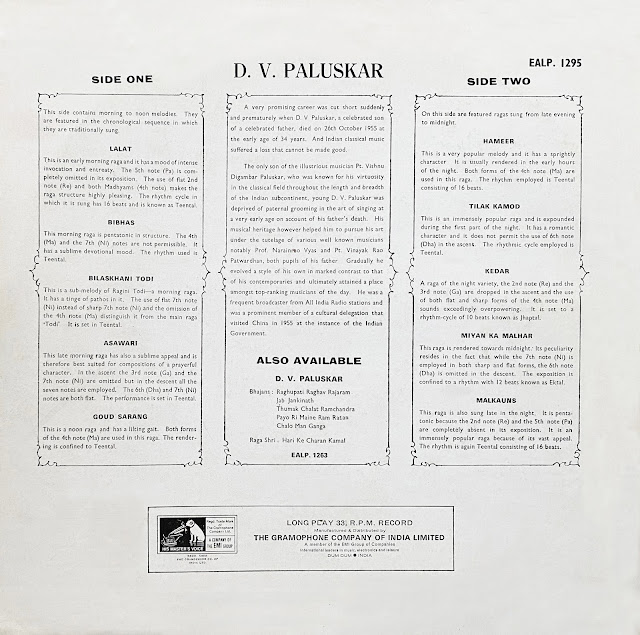
INDIA – INDE Pandit D. V. Paluskar – His Master’s Voice – EALP 1295

INDIA – INDE

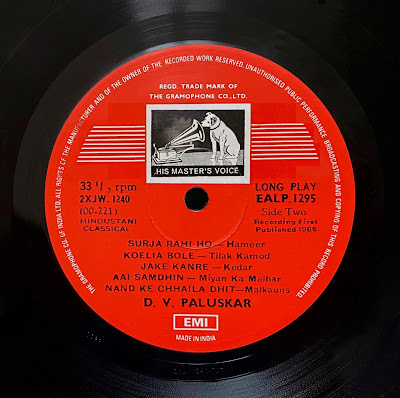
Pandit D. V. Paluskar – His Master’s Voice – EALP 1295, released 1965 (LP)

#India #Inde #Hindustani #D. V. Paluskar #Vishnu Digambar Paluskar # Gharana #Indian music #musique indienne #traditional music #world music #vinyl #MusicRepublic #raga # Vishnu Narayan Bhatkhande

Dattatreya Vishnu Paluskar, aka D.V. Paluskar (1921–1955), born into an eminent musical family in the holy city of Nashik, near Mumbai, Maharashtra, was a major 20th century Hindustani vocalist. His father Vishnu Digambar Paluskar (1872-1931) was a master of the Gwalior Gharana and a renaissance man who pioneered the popularization of classical and devotional music among the masses.

Paluskar senior viewed music as the expression of deep religious faith and devotion, and trained his prodigiously gifted son until his death in 1931 when D.V. was ten. D.V.
 completed his apprenticeship under the guidance of two of his father’s most accomplished disciples Vinayakrao Patwardhan (1898-1975) and Narayanrao Vyas (1902-1984).


D.V. Paluskar got his first major exposure on the Indian classical music stage at his debut performance at the Harvallabh Sangeet Sammelan in Punjab at the age of 14. By performing frequently throughout the country, All India Radio broadcasts of his music and Paluskar’s many 78 RPM releases, Paluskar quickly established himself as a highly esteemed and immensely popular artist.


This excellent 1965 reissue of Paluskar 78 RPMs showcases his masterful free-flowing melodious lyrical singing delivered with understated perfection.


Around the time of India’s Independence in 1947, Paluskar championed his father’s double legacy as a worthy and devout torchbearer of tradition and a modernist in sync with changing times and tastes, willing to reach out to new audiences. His sudden death in 1955 at the age of 34 following an encephalitis brain inflammation was a truly tragic loss.


Dattatreya Vishnu Paluskar, ou D.V. Paluskar (1921–1955), né dans une éminente famille musicale dans la ville sainte de Nashik, près de Mumbai, Maharashtra, fut un chanteur Hindustani majeur du XXe siècle. Son père, le maître du Gwalior Gharana Vishnu Digambar Paluskar (1872-1931), fut un visionnaire qui s’évertua à diffuser la musique classique et dévotionnelle auprès du plus grand nombre.


Paluskar père, qui considérait la musique comme l'expression de la foi et de la dévotion religieuse, forma son fils surdoué jusqu'à sa mort en 1931 alors que D.V. n’avait que dix ans. Ce dernier pursuivit son apprentissage sous la tutelle de deux des plus grands disciples de son père Vinayakrao Patwardhan (1898-1975) et Narayanrao Vyas (1902-1984).


A l'âge de quatorze ans, D. V. Paluskar fît sensation sur la scène de la musique classique indienne lors de son premier concert au Harvallabh Sangeet Sammelan au Pendjab. En se produisant par la suite fréquemment dans tout le pays, en bénéficiant d’une diffusion nationale de sa musique par la All India Radio, et en publiant des 78 tours trés prisés, D. V. Paluskar s'impose à la fois comme un artiste immensément populaire et tenu en haute estime par ses pairs.


Cette excellente collection de 78 tours publiée en 1965 présente la grande maestria tout en retenue de son chant fluide, lyrique et mélodieux.


À l'ère de la renaissance culturelle à l'époque de l'indépendance de l'Inde en 1947, Paluskar défendait ainsi le double héritage légué par son père : être un digne héritier de la tradition, ainsi qu'un moderniste en phase avec l'évolution de son temps et des goûts musicaux, désireux d'atteindre de nouveaux publics. Sa mort soudaine en 1955 à l'âge de 34 ans suite à une encéphalite fut réellement une perte tragique.


* * *

In Great Masters of Hindustani Music (1981), Susheela Misra (1922-1998) praises the role musicologist Vishnu Narayan Bhatkhande (1860-1936) – who wrote the first modern treatise on Hindustani classical music – and D.V. Paluskar’s father Vishnu Digambar Paluskar had in salvaging Hindustani music:


“Music was one of the casualties of foreign rule in our country. In the lethargic age which preceded our political struggle, this fine art fell from its high pedestal into low, illiterate society, and lay there uncared for, and looked down upon. It were the two Vishnus, Vishnu Narayan Bhatkhande and Vishnu Digambar Paluskar who salvaged our music which had been submerged for years under the cold waves of public apathy and alien contempt.


Thanks to these two reformers, however, today Hindustani classical music is no longer confined to an esoteric circle, but is an art within the reach of every aspiring home.”

Download:

#India #Inde #Hindustani #D. V. Paluskar #Vishnu Digambar Paluskar # Gharana #Indian music #musique indienne #traditional music #world music #vinyl #MusicRepublic #raga # Vishnu Narayan Bhatkhande

Photographs below are from Yantra: The Tantric Symbol of Cosmic Unity by Madhu Khanna, Thames & Hudson, 1979, and Arts of India: 1550-1900, Victoria & Albert Museum, 1990:

The human body is considered the best of all Yantras. The seven psychic centers, or Chakras, on the axis of the spine are activated in sequence during meditation. From the root Chakra upwards, they are Known as Mūlādhāra, Svādishthāna, Manipūra, Anāhata, Viśuddha, Ājña and Sahasrāra.
Copper with gold wash, South India, c. 18th century:

MusicRepublic INDIA – INDE Pandit D. V. Paluskar – His Master’s Voice – EALP 1295

H. H. Shahu Chhatrapat 
(1875-1922), Maharaja of Kohlapur, Maharashtra, photograph 1894:

MusicRepublic INDIA – INDE Pandit D. V. Paluskar – His Master’s Voice – EALP 1295

The Maqbara (mausoleum) of Vizir Sahib Baha-ud-Din Bhar, Junagadh, Gujarat, photograph 1900:

MusicRepublic INDIA – INDE Pandit D. V. Paluskar – His Master’s Voice – EALP 1295


Please help me purchase important traditional records to pursue my global 

curation project and share the best finds with you on this blog: