BENIN – BÉNIN
On my second trip to the North of Benin, in 1992, I was stranded in a bush taxi north of Parakou at an informal stop while the driver waited to fill every seat in the van before continuing to our destination. Bush taxi stops could last anywhere from 15 minutes to 7 hours, always a step into the unknown, so you'd better have time on your hands and, even more important, be able to appreciate the quality moments and interactions that occur when you go with the flow come what may…


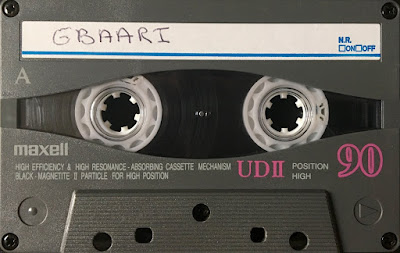
Gbaari - Bariba music from
the Radio Parakou archives, copied in June 1996, probably recorded in the late 1980s
(Cassette)


On my second trip to the North of Benin, in 1992, I was stranded in a bush taxi north of Parakou at an informal stop while the driver waited to fill every seat in the van before continuing to our destination. Bush taxi stops could last anywhere from 15 minutes to 7 hours, always a step into the unknown, so you'd better have time on your hands and, even more important, be able to appreciate the quality moments and interactions that occur when you go with the flow come what may…
Suddenly my fellow
travelers and I were awakened from our torpor by music from a boom box that was
both skillful and uplifting. My neighbor lit up, explaining that it was the
group Gbaari, and an elderly woman had the irresistible urge to get
out of the taxi to dance, drawing cheers and laughing approval in a moment of
true excitement. I was hot, sweaty, hungry, stiff and plastered with dust, but
in that moment I felt thoroughly alive.
When I returned
four years later, I went to Radio Parakou with ten blank cassettes to copy some
of their archived music, including Gbaari. (I will feature a
selection of Bariba, Dendi and Fulani Peul traditional music from the Parakou
region in future posts)
Gbaari’s use of
electric bass & guitar and drums definitely make them an urban
neo-traditional outfit, playing delicious, jumpy music backed by
juvenile-sounding female voices, yet firmly rooted in the Bariba musical
tradition. These 15 tracks could very well be Gbaari’s entire recorded
output.
Lors de mon
deuxième voyage au nord Bénin en 1992, je me suis retrouvé à l’arrêt dans un
taxi brousse au nord de Parakou afin que notre chauffeur puisse remplir
chaque cm3 de son véhicule avant de continuer notre route. Ces escales
imprévues – pouvant durer de 15 minutes à 7 heures – sont toujours un pas dans
l'inconnu, alors mieux vaut ne pas être pressé et, surtout, savoir profiter des
moments de qualité et des interactions qui se produisent inéluctablement
lorsque vous vous laissez aller à l’inspiration du moment, advienne que pourra
...
Mes compagnons de voyage
et moi sortons soudainement de notre torpeur à l’écoute d’une musique fraîche
et revigorante sortant bruyamment d’un ghetto-blaster. Le visage de
mon voisin s'illumina, m’expliquant que c'était la musique du groupe Gbaari, et
une vénérable tantie eut l'envie irrésistible de sortir du taxi pour effectuer
quelques pas de danse, sous les vivats et des rires approbateurs, dans un
moment de véritable excitation. J'avais chaud, j’étais en sueur, j'avais faim,
j'étais courbaturé et couvert de poussière, mais à ce moment précis, je me
sentais vivre pleinement, en symbiose avec les personnes et l’ambiance
autour de moi.
Lorsque je suis
revenu quatre ans plus tard, je me suis rendu à Radio Parakou avec dix
cassettes vierges pour copier une partie de leurs archives, y compris Gbaari.
(Je présenterai une sélection de musiques traditionnelles Baribas, Dendis et Peuls de la région de Parakou dans de prochains posts).
L'utilisation de la
basse et de la guitare électrique et de la batterie fait de Gbaari un ensemble
néo-traditionnel résolument moderne, jouant de la musique délicieuse et
entrainante, soutenue par des voix de jeunes femmes, mais fermement enracinée
dans la tradition musicale Bariba. Ces 15 plages pourraient très bien être les seuls
enregistrements de Gbaari.
Download
MP3
The
photographs below, from my first trip to Parakou in 1990, show a blind
wandering griot singing and playing his guitar with young kids standing by
sharing the shade of a tree against the scorching midday sun:


