Tuesday, November 8, 2022

NIGERIA – NIGÉRIA Yusufu Olatunji & His Group – Vol. 24 – Zareco ORSL 1717

NIGERIA – NIGÉRIA

Yusufu Olatunji & His Group – Vol. 24  Zareco ORSL 1717, released 1976 (LP)

#Nigeria # Sakara #Yoruba #Yusufu Olatunji #traditional music #African Music #musique traditionnelle #musique Africaine #goje #sakara drum #Islamic music #world music #vinyl #MusicRepublic #world music

We now highlight another great album by Sakara singer and goje violin player Yusufu Olatunji (1909-1978), one of the finest African traditional artists ever recorded. Sakara music is a deep Yoruba traditional genre tinged with Arab-Islamic influences here featuring male voices, percussion accompanying the great master’s singing and goje playing. This brilliant slow-moving flow of delicate, complex and majestic music radiates peace, fire and lofty dignity.


Nous présentons maintenant un nouvel album magnifique du chanteur et joueur de violon goje Yusufu Olatunji (1909-1978), un artiste traditionnel africain majeur. La musique Sakara est un genre traditionnel yoruba teinté d’influences arabo-islamiques avec des voix d’hommes et des percussions accompagnant la voix et le jeu de violon goje du grand maître. Ce flux sonore complexe, brillant et délicat rayonne de paix, de feu et de noble plénitude.


Download:

Many thanks to Joāo for sharing this rare record and Nuno for helping with the visuals here.

Our other Yusufu Olatunji Sakara posts:

Yusufu Olatunji & His Group - Vol. 17  Philips PL 636 1050 here

Yusufu Olatunji & His Group - Vol. 20  ORSL 1708 here

Yusufu Olatunji & His Group - Vol. 18  ORSL 1706 here 


Photographs below are from Heroic Africans – Legendary Leaders, Iconic Sculptures by Alysa LaGamma, The Metropolitan Museum of Art, 2011:

Yoruba terracotta heads, Iwinrin Grove, Ife, Nigeria, c. 1931:


MusicRepublic – NIGERIA Yusufu Olatunji & His Group – Vol. 24 – Zareco ORSL 1717


Yoruba terracotta head, Ife, Nigeria, 12th-15th century:


MusicRepublic – NIGERIA Yusufu Olatunji & His Group – Vol. 24 – Zareco ORSL 1717

Please help me purchase important traditional records to pursue my global 

curation project and share the best finds with you on this blog:


Wednesday, November 2, 2022

INDIA – INDE Siddheswari Devi – Light Classical Vocal – His Master’s Voice – EALP 1436

INDIA – INDE
Siddheswari Devi (1908-1977) – Light Classical Vocal – His Master’s Voice – EALP 1436, released 1985 (LP)

#India #Inde #Siddheswari Devi #Hindustani #vocalist #Thumris #Khayals #Dadras #Tappas #Kajaris #Chaitis #Bhajans #Indian music #raga #traditional music #world music #vinyl #MusicRepublic

Side 1:

Thumri - Misra Tilang


#India #Inde #Siddheswari Devi #Hindustani #vocalist #Thumris #Khayals #Dadras #Tappas #Kajaris #Chaitis #Bhajans #Indian music #raga #traditional music #world music #vinyl #MusicRepublic

Side 2:

1. Tappa - Bhairavi

2. Dadra - Gara


#India #Inde #Siddheswari Devi #Hindustani #vocalist #Thumris #Khayals #Dadras #Tappas #Kajaris #Chaitis #Bhajans #Indian music #raga #traditional music #world music #vinyl #MusicRepublic

#India #Inde #Siddheswari Devi #Hindustani #vocalist #Thumris #Khayals #Dadras #Tappas #Kajaris #Chaitis #Bhajans #Indian music #raga #traditional music #world music #vinyl #MusicRepublic

Originally posted by Tawfiq, who passed away in April 2019, on his great blog oriental-traditional-music.blogspot.com on September 11, 2013.


 *********

Download:

MP3 


https://music-republic-world-traditional.blogspot.com/

"With the passing away of Siddheswari Devi on March 18 1977, the last of the four great pillars of Hindustani light classical music is gone. First went Begum Akhtar in 1974 at the age of 60, and then her older contemporaries, Rasoolan Bai, Badi Moti Bai and Siddheswari Devi. All four of them were inheritors of great traditions of music from a glorious era of the past when music dominated the lives of musicians from childhood to death. They were musical 'stars' who shone brilliantly in the courtly era; but when the 'darbari' era ended they did not hesitate to step out into the glare of public acclaim. 


Thumris were once sung with abhinaya. When classicists began to frown down on this type of music with abhinaya, the singers took to the Bol-Banav-ki Thumri in which the emotional contents of songs are effectively brought out through vocal expressiveness only, that is, beauty of notes, voice modulations swara-combinations, and a specially emotion-charged style of singing. Bhaiya Ganpatrao, Moizuddin, and Shyamlal Khatri were some of the trail-blazers who gave this modern orientation to Thumri. Among those who have kept up these traditions till now in full glory, the outstanding names of this century have been Siddheswari Devi, Rasoolan Bai, Badi Moti Bai, Begum Akhtar, Mahadev Prasad Misra, and Girija Devi. Girija Devi is far younger than the others, and is of a different generation.


Born into a famous musical family in Varanasi in 1903, Siddheswari traced her musical lineage to her maternal grandmother Maina Devi, a reputed singer of Kashi of nearly a century ago. She was the inheritor of great musical traditions from a family which produced several famous singers like Maina Devi, Vidyadhari Devi, Rajeswari Devi and Kamaleswari Devi. As Siddheswari lost her mother when she was barely 18 months old, she was brought up by her maternal aunt, Rajeswari, who was a famed disciple of Maina Devi, Mithailal, and of the great Moizuddin himself. Brought up in this musical atmosphere, Siddheswari absorbed a great deal of the art right from her infancy. Her childhood was an unhappy one as she lost her father also very soon. About this period of her life, she once said : "We did not have luxuries like the gramophone. But our neighbours had one. I used to go to them to listen to the records of popular singers like Janaki Bai, Gauharbai and several others. How their music used to captivate me!".


Noticing the talent and eagerness of the young girl, Siyaji Maharaj began to teach her. Siyaji's father Shyamacharan Misra, and uncle Ramcharan Misra had been good musicians. About her guru, Siddheswari used to say : "No one could possibly get a more generous and affectionate guru. Having no children of his own, he treated me like his own daughter. He taught me all the basic ragas and a large number of Khayals, Tappas, and Taranas. He taught me with all his heart, and I practised my music with intense concentration and devotion. Nowadays, alas! the students are all in a hurry to acquire a diploma or a degree; they have no lagan".


After the death of Siyaji Maharaj, she learnt for a while from Ustads Rajab Ali Khan of Dewas, and Inayat Khan of Lahore. However, her greatest guru, the one to whom she attributes most of her musical training was none other than Bade Ramdasji of Varanasi. Her face glowed with pride and veneration whenever she spoke about this generous guru who taught the eager disciple magnanimously. Nostalgically recalling those times of close guru-shishya bonds, Siddheswari once remarked to me: "The age of such great and generous gurus seems to have gone. No longer does one come across the really devoted type of pupils either. Today they are all in such a hurry".

Later on in life, when she joined the Bharatiya Kala Kendra in Delhi as a professor, she earned the reputation for being a sincere and conscientious teacher. When I mentioned this to her, she simply remarked : "Why not, Beti? Let something of my treasures remain with others after l am gone".


Siddheswari made her unforgettable debut at a Calcutta conference many many decades ago. Young Siddheswari's name was billed along with those of many of the veterans of the time, such as Pt. Omkarnath Thakur, Pt. Dilip Chandra Vedi, Ustad Faiyaz Khan and others. Her khayals in Malhar and Suha-Sughrai, and her thumris, elicited high praise and medals galore from Pt. Omkarnathji and Ustad Faiyaz Khan. Another glorious performance of her's was in the All India Music Conference in Bombay in which Ustads Bade Ghulam Ali Khan and Faiyaz Khan also were to sing. Siddheswari concluded her superb recital with such an intensely emotional rendering of the Bhairavi-Thumri (Kaahe Ko daari re gulal Brajlal Kanhayi) that the Aftab-e-Mausiqui [the Sun of Music/ Faiyaz Khan] refused to sing after her! He said to her : "After such music there is no room for any more. After Gauhar Malika, the crown of the Thumri rests on your head". Such was the grand magnanimity of the musical giants of the past!


After her first concert appearance at the age of 18, she began to receive invitations for performances in Rampur, Jodhpur, Lahore, Mysore and various other states which used to patronise classical music during that time. In the next 4 or 5 decades, she sang in many royal durbars, music conferences national programmes, radio concerts and so on until she became "an institution by herself in view of her enormous repertory and heritage of a rich musical tradition." In recognition of her valuable contributions to the enrichment and perpetuation of the Banaras (Poorab) ang of light classical music, Siddheswari was honoured with the Presidential Award in 1966, the Padmasri in 1967 the D. Litt from Rabindra Bharati University, Calcutta, and the title of "Desikottama" from the Viswa Bharati University. When we felicitated her on the Award, her humble and philosophical reply was : "It's all very well; but I shall continue to deserve these, only as long as I can go on singing well enough to please you all". In spite of all the fame that she earned, she remained simple, unassuming and homely till the end. Among contemporary musicians, Kesarbai Kerkar and M.S. Subbalakshmi were the artistes she admired most.


Few musicians in recent times had such a vast repertoire as Siddheswari had. Her rich storehouse included a large number of Khayals, Thumris, Dadras, Tappas, Kajaris, Chaitis and Bhajans. "A feeling heart, a fecund mind, and an expressive voice" are the prime requisites for a good light classical singer. Even when her voice had become "temperamental and thick" in old age, she could make up for it by a rare emotional fervour, and she could hold her audiences by her mood of intense absorption and her ability to bring out the emotional contents of the romantic or devotional themes. Siddheswari's music brought out all the salient features of the Banaras style, such as simple charm, intensity of feeling, and effective expression of emotions through sheer purity of notes, "meends" and voice modulations. She said to me once: "Although my thumri is fully of the Banaras ang, I incorporate elements of the Khayal into it. You may say that my thumri- singing is Khayal angapradhan". She added spice and charm by sprinkling short, swift tappa-like taans and trills. In her early days, she was deeply impressed by the singing of Gauharjan, Zohrabai, and Malikajan. As a member of cultural delegations, Siddheswari gave recitals in Rome, Kabul, and Kathmandu.


Siddheswari cherished not only the songs galore that she had learnt from her revered guru Bade Ramdasji, but also the lofty principles that he impressed on his disciples. He used to advise her: "Music is the medium for pleasing and attaining God. You should never feel proud of any success. Always remain humble. The day your tears flow during your sangeetsadhana, your music will have attained mellowness and maturity".


No wonder she always believed that both "Siddhi" and "Ishwar" can be attained through devoted sangeet-sadhana. Her deeply religious temperament had a great impact on her singing. In the last years of her life, the Pukaars in her Thumris and Bhajans were like cries from an anguished devotee's heart. With eyes closed, mind absorbed, and left hand cupping her left ear (to receive the full drone of the Tanpura), she used to pour her heart out through her music. Siddheswari remained a most warm-hearted, simple, and loveable person, "an extraordinary amalgam" of innocence, courage, humour, generosity, youthful zest for life, and a rare dignity. Her life was, by no means, a happy or smooth one. She had an unhappy childhood and "an emotionally tumultuous" youth, and she had to undergo many bitter experiences in life. But all of these seem to have added to her natural dignity, strength and wisdom. One of her admirers described her as "a vast reservoir of warmth, an unfailing fountainhead of inspiration, a manifestation of humanity at its most compelling and earthy.... and yet a being full of sparks and sudden vertical ascents to the mystic regions where inspiration has its divine origins". She did not have the facilities to devote herself to sadhana; living like a recluse. She practised her music all the time, while she was cooking, washing clothes, or doing any of the ordinary household chores. Music was her very Iife.


The death of Siddheswari Devi has left a big void in the world of light classical music. Shanta Devi, her elder daughter whom she had trained up to follow her footsteps has remained in obscurity owing to poor health. Surprisingly, it is her younger daughter Savita Devi who has zoomed into the limelight as a delightful and popular singer, and it is Savita who shows every sign of taking her illustrious mother's place. Versatile and attractive Savita is not only a graduate (an M.A, and Sangeetalankar) and a good Sitariya, but she has also shaped into a confident and popular vocalist with a wide repertoire of Khayals, and light classical varieties. Gifted with an appealing, melodious voice covering 3 octaves or more, she has undergone years of training in khayals under Pt. Moni Prasad of the Kirana gharana. She has a natural flair for the light classical varieties in which she was extensively trained by her mother whom she used to accompany as a supporting singer in many concerts. While working as Head of the Department of Music in Daulatram College (University of Delhi), she is continuing her own music riyaz tirelessly.


Many years before her death, Siddheswari had once told me: "My greatest ambition is to die while singing a perfect taan. I feel closest to God when I am lost in my music." Begum Akhtar also had expressed an almost identical wish which was fulfilled because she died in the peak of her glory, giving a memorable performance before the dropping of the final curtain.

But Siddheswari who lived till her seventies, had no such luck. She had been helplessly bed-ridden for many months prior to the sad end. In a TV interview prior to her last illness, she had confessed with dignity:- "There was a time when I used to sing for the public. Now I sing to please my God. My soul craves to go back to its original abode".

Malini Menon, one of Siddheswari's pet-pupils who had become more like a daughter to her, writes: "Maa remained a student all her life... She had a child-like thirst for knowledge and she was ever so generous as she could not bear to see anybody in want... Maa was turbulent as the waves, and yet calm like the distant sea. She was at peace with herself and had prepared for the journey of the soul to eternity. When the moment came, she accepted it with grace".


Siddheswari Devi's last brilliant recital was in the Radio Sangeet Sammelan (a couple of years before her end) in which she sang with a bubbling, youthful zest, accompanied on the Sarangi by Pt. Gopal Misra (who is no more), and on the Tabla by Ramji Misra. Eyes twinkling, the solitary diamond in her big nose ring flashing points of light, a warm smile on her paan-reddened lips, Maa's homely figure emerges in one's memory. But as soon as she sat on the stage for a recital, one realised that she belonged to an entirely different world, and that her life had known "no horizons other than music". As I recall that last inspiring recital of hers in the Radio Sangeet Sammelan, memories of several other great past concerts of this music-devotee come to my mind, and her plaintive Jogiya echoes in my memory:"O Jogi ! Constantly uttering the name of Rama, you have become one with Him, leaving your little hut so empty".*

*Susheela Misra’s Great Masters of Hindustani Music (1981).


See: http://en.wikipedia.org/wiki/Siddheshwari_Devi


Please help me purchase important traditional records to pursue my global 

curation project and share the best finds with you on this blog:


Tuesday, October 25, 2022

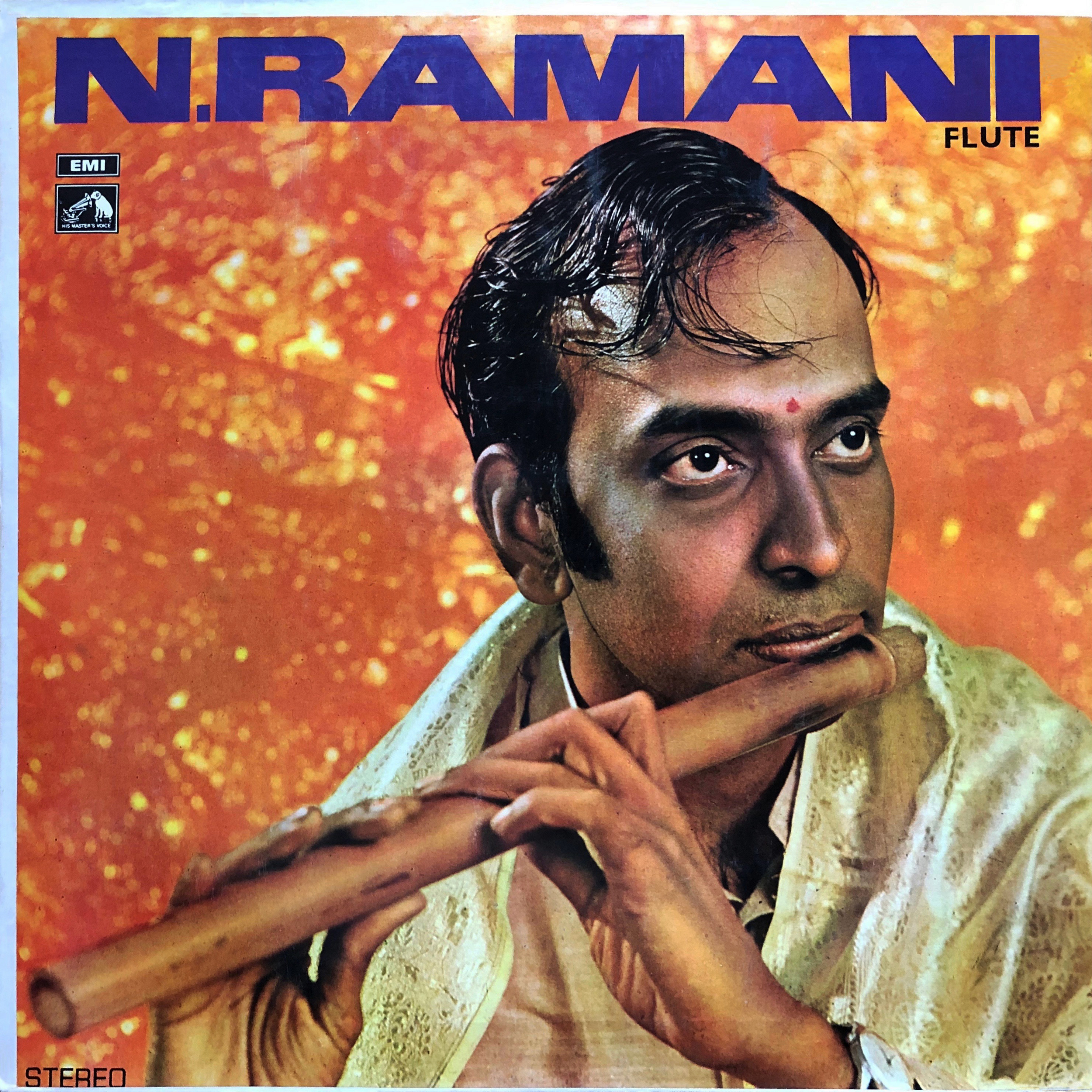
INDIA – INDE N. Ramani – Flute – His Master’s Voice – EASD 1390

INDIA – INDE
N. Ramani – Flute – His Master’s Voice – EASD 1390, released 1973 (LP)

#India #Inde #Carnatic #N. Ramani #Tiruvarur #Tamil Nadu #venu #flute # T.R. Mahalingam #M.S. Gopalakrishnan #violin # Vellore Ramabhadran # mridangam #Shyam Sundar #kanjira #His Master’s Voice #indian music #vinyl #MusicRepublic #world music #traditional music

Natesan Ramani (1934-2015), aka as N. Ramani, was born into an illustrious musical family in Tiruvarur, Tamil Nadu, and was first tutored in the Carnatic flute by his maternal grandfather singer and flautist Azhiyur Narayanasami Iyer (1878-1941).


Although stories of Lord Krishna’s enchanting flute melodies abound in Hindu mythology, the Carnatic eight-hole bamboo flute was not used as a solo concert instrument until the late 19th century.

Ramani’s maternal uncle T.R. Mahalingam (1926-1986), who played a central role in popularizing the Carnatic flute in the 20th century, accepted him as a disciple in 1943. A few years later, Ramani moved to Chennai, where Mahalingam lived, to pursue his apprenticeship. By expanding on his mentor’s flute playing techniques, while also studying the long North Indian bass bansuri flute, developed by the great Pannalal Ghosh (1911-1960), Ramani quickly established himself as a major soloist and innovator on the Indian classical music scene.


Ramani toured widely in India and abroad, first with Mahalingam, and then with a host of Carnatic and Hindustani luminaries, including violinists M.S. Gopalakrishnan (1931-2013) and T.N. Krishnan (1928-2020), vocalists Balamuralikrishna (1930-2016) and Pandit Jasraj (1928-2020), sarodist Amjad Ali Khan (b. 1945), and flutist Hariprasad Chaurasia (b. 1938). In 1966, he began a groundbreaking collaboration with violinist Lalgudi Jayaraman (1930-2013) and veena player R. Venkataraman (1938-2010) to form a highly acclaimed Veena-Venu-Violin trio (see my Jayaraman post here).


In addition to his many stage performances, Ramani was also a dedicated teacher who founded the Ramani Academy of Flute and trained more than 100 disciples.


This gorgeous album showcases the maestro’s exquisite Carnatic vocal-like venu flute playing (and bass flute on B2) in a luminous dialogue with the eminent violinist M.S. Gopalakrishnan, Vellore Ramabhadran (1929-2012) on mridangam and Shyam Sundar on kanjira to craft delicate, sprightly, and mellifluous soundscapes.


Natesan Ramani (1934-2015), ou N. Ramani, né dans une illustre famille de musiciens à Tiruvarur dans le Tamil Nadu, commence dès son plus jeune âge a apprendre la flûte carnatique auprès de son grand-père maternel, le chanteur et flûtiste Azhiyur Narayanasami Iyer (1878-1941).


Bien que les récits sur les mélodies enchanteresses de la flûte de Krishna abondent dans la mythologie hindoue, la flûte Carnatic à huit trous n’est utilisée comme instrument de concert solo qu’à partir de la fin du 19ème siècle.


L'oncle maternel de Ramani, T.R. Mahalingam (1926-1986), qui joua un rôle central dans la popularisation de la flûte Carnatic au XXe siècle, l'accepte comme disciple en 1943. Ramani s’installa quelques années plus tard à Chennai, où vécu Mahalingam, afin de poursuivre son apprentissage. En développant les techniques de jeu de flûte de son maître tout en étudiant la flûte basse bansuri d'Inde du Nord développée par le grand Pannalal Ghosh (1911-1960), Ramani s'impose rapidement comme un soliste et un innovateur de tout premier plan sur la scène musicale indienne classique.


Ramani participa à de nombreuses tournées en Inde et à l'étranger, avec son mentor Mahalingam, puis avec des grands musiciens Carnatic et Hindustani, tels les violonistes M.S. Gopalakrishnan (1931-2013) et T.N. Krishnan (1928-2020), les chanteurs Balamuralikrishna (1930-2016) et Pandit Jasraj (1928-2020), le joueur de sarod Amjad Ali Khan (né en 1945) et le flûtiste Hariprasad Chaurasia (né en 1938). À partir de 1966, il entame également une collaboration originale et novatrice avec le violoniste Lalgudi Jayaraman (1930-2013) et le joueur de veena R. Venkataraman (1938-2010) pour former un trio Veena-Venu-Violon encensé par le public et la critique (voir le post de Jayaraman ici).


En plus de ses nombreux récitals, Ramani fut également un professeur dévoué qui fonda la Ramani Academy of Flute et forma plus de 100 disciples.


Ce magnifique album présente l'exquis jeu de flûte venu Carnatic du maestro (qui joue de la flûte basse sur B2) dans un dialogue lumineux avec l'éminent violoniste M.S. Gopalakrishnan, Vellore Ramabhadran (1929-2012) au mridangam et Shyam Sundar au kanjira créant des paysages sonores délicats, vifs, et lyriques.

Download:


Our other post featuring N. Ramani:

Lalgudi Jayaraman  Violin Venu Veena – HMV ECSD 2494 here


The photographs below are from the British Museum’s online collection here and L'Inde Que J'Aime by Nicole Ménant, photographs by Jean-Louis Nou, Editions Sun, 1968:


Manuscript painting of Krishna with inscription. He is portrayed here as the lover par excellence, a dark-skinned handsome youth playing the flute and ravishing the hearts of the local Gopis, with his appearance and haunting melodies. The melody magically causes each of the Gopis to imagine that He is dancing with her alone. Drum and cymbal players at the bottom left accompany the wild gyrations of the besotted Gopis

Painted on paper. Udaipur style, Rajasthan, c. 1630-1640:


MusicRepublic – INDIA – N. Ramani – Flute – His Master’s Voice – EASD 1390

Ramanathaswamy Temple and its infinite corridors, Tamil Nadu:

MusicRepublic – INDIA – N. Ramani – Flute – His Master’s Voice – EASD 1390

Please help me purchase important traditional records to pursue my global 

curation project and share the best finds with you on this blog:


Tuesday, October 18, 2022

ITALY – ITALIE Italia Vol. 1 – I Balle Gli Strumenti I Canto Religioso (Dances / Musical Instruments / Religious Songs) – Albatros VPA 8082

ITALY – ITALIE

Italia Vol. 1 – I Balle Gli Strumenti I Canto Religioso (Dances / Musical Instruments / Religious Songs) – Albatros VPA 8082, curated by Roberto Leydi (LP)

#Italia #Italy #Italie #Roberto Leydi #Diego Carpitella #Albatros label #Zampogne #Bagpipes #Launeddas #concertina #friction drum #Polyvocal singing #religious music #traditional music #world music #Italian music # Sardinia #polyphony #Sicily #Abruzzo #Emilia #Puglia #MusicRepublic #vinyl


This Italian folk and religious music LP on the essential Albatros label – curated by the eminent ethnomusicologist Roberto Leydi (1928-2003) – offers a compelling glimpse into the rich musical heritage of the four corners of Italy, featuring Sardinian polyvocal singing (A11, B2, B10), a brass band (A4), a cello (A1), violins and fiddles (A1, A3, A7), an accordion (A2), concertinas (A5, A7, B7), bagpipes (B3), polyphonic launedda triple clarinets (A9, A10), an oboe (B3), guitars (A3, A6, A7), a Jew's harp (A8), a friction drum (A5), castanets (A6), tambourines (A7, A10), a triangle (A10).


Cet album de musique folklorique et religieuse italienne sur l'incontournable label Albatros – dont les morceaux sont sélectionnés par l'éminent ethnomusicologue Roberto Leydi (1928-2003) – offre un aperçu du riche patrimoine musical issu des quatre coins de l'Italie, avec des chants polyvocaux Sardes (A11, B2, B10), une fanfare (A4), un violoncelle (A1), des violons (A1, A3, A7), un accordéon (A2), des concertinas (A5, A7, B7), des cornemuses (B3), des triple clarinettes polyphoniques launeddas (A9, A10), un hautbois (B3), des guitares (A3, A6, A7), une guimbarde (A8), un tambour à friction (A5), des castagnettes (A6), des tambourins (A7, A10), un triangle (A10).


Dances and Musical Instruments


Northern Italy
        

A1 – Rezianka Zagatina - San Giorgio Di Resia (Udine, Friuli),

Cello – Riccardo Coss, violin – Giovanni Di Lenardo, Lino Micelli,

Recorded by Alberto Negrin in 1967.


A2 – Furlana (Modena, Emilia),
Accordion – Davide Frati,

Recorded by Roberto Leydi in 1958.


A3 – Valzer - Barigazzo (Modena, Emilia),

Fiddle – Mario Tazzioli, guitar – Oreste Tazzioli,

Recorded by Roberto Leydi in 1958.


A4 – Monferrina - Tonco (Asti, Piemonte),

Unknown Brass Band,

Recorded by Roberto Leydi in 1965.


Central Italy
      

A5 – Saltarello - Cerqueto Di Fano Adriano - Teramo (Abbruzzo),

Concertina – Carino Misantoni, friction drum – Alfonso Marconi,

Recorded by Diego Carpitella, Nicola Jobbi and Roberto Leydi in 1966.


Southern Italy
         

A6 – Tarantella - Carpino (Foggia, Puglia),

Castanets – Rocco Di Mauro, guitars – Andrea Sacco, Gaetano Basanisi, Michelantonio Maccarone, voice – Andrea Sacco,

Recorded by Diego Carpitella and Roberto Leydi in 1966.


A7 – Pizzica Tarantata - Nardò (Lecce, Puglia),

Concertina – Pasquale Zizzari, fiddle – Luigi Stifani, guitar – Giuseppe Ingusci, tambourine – Salvatora Marzo,

Recorded by Diego Carpitella and Roberto Leydi in 1966.


Sicily
         

A8 – Assolo of Marranzanu (Jew's Harp) - Catania (Sicilia),

Jew's harp – Giuseppe Giuffrida,

Recorded by Roberto Leydi in 1956.


Sardinia                 

A9 – Assolo of Launeddas for Ballo Tondo (Circle Dance) - Maralacagonis (Cagliari, Sardinia),

Launeddas
 – Feliciano Pili,

Recorded by Diego Carpitella in 1967.


A10 – S'Arrusciada (Circle Dance) - Maralacagonis (Cagliari, Sardinia),

Panpipes – Francesco Ligas, tambourine – Silvio Falqui, triangle – Cesare Pisu,

Recorded by Diego Carpitella in 1967.


A11 – Sus Tenores Dance - Orgosolo (Nuoro, Sardinia),

Four unknown male singers,

Recorded by Diego Carpitella in 1955.


A12 – Dance - Orgosolo (Nuoro, Sardinia),

Concertina – Antonio Angelo Goddi,

Recorded by Diego Carpitella in 1967.


Religious Songs


Christmas Cycle
        

B1 – Vo Girand Per Gli Osterie (I'm Making the Tavern Rounds) - Ripalta Nuova (Cremona, Lombardia),

Singers – Luigina Bettinelli, Natalina Bettinelli,

Recorded by Roberto Leydi in 1967.


B2 – Su Pizzineddu / The Little Boy - Orgosolo (Nuoro, Sardinia),

Unknown singer,

Recorded by Diego Carpitella in 1967.


B3 – Novena di Natale / Christmas Carol - (Caserta, Campania),

Unknown singer, bagpipe and oboe players,
Reissue of 78 rpm ODEON 9066 B recorded c. 1935.


Canti Dedicati Alla Madonna E I Santi / Songs Dedicated to the Cult Of Mary and Saints
         

B4 – San Gioacchino Stava Sui Monti / St. Joachim Was On The Mountain - Cassago (Como, Lombardia),

Singer – Angelina Brenna,

Recorded by Bruno Pianta and Mathias Deichmann in 1965.


B5 – La Vita Di Sant'Alessio / The Story Of St. Alexis - Cerqueto Di Fano Adriano (Teramo, Abbruzzo),

Singer – Isabella Di Matteo,

Recorded by Diego Carpitella, Nicola Jobbi, Roberto Leydi in 1966.


B6 – Litanie Per Il Pellegrinaggio Alla Madonna Di Montevergine / Litanies for Pilgrimage at Montevergine Sanctuary Castelpoto (Campobasso, Molise),

Unknown singer,

Recorded by Anabella Rossi and Roberto Leydi in 1966.


B7 – Canto Di Questua Per La Festa Di Sant'Antonio / Carol for St. Anthony's Day – Cerqueto di Fano Adriano (Teramo - Abruzzo),

Unknown singer and concertina player,

Recorded by Nicola Jobbi in 1965.


Settimana Santa / The Passion Week Cycle

B8 – Tu Chi Dormi Naa Stu Lettu / Vinniri Santu E Vinniri Matinu / "You Who Sleep In This Bed / Good Friday and Friday Morning - Cianciulli (Palermo, Sicily),

Singers – Andrea Ciprè, Angelo Barrale, Gaspare Napoli, Giuseppe Patti, Salvatore Faraone,

Recorded by Elisabetta Giggino in 1966.


B9 – L'Orologio Della Passione / The Passion Hours - Cerqueto di Fano Adriano (Teramo, Abbruzzo),

Unknown singer and friction drum player,

Recorded by Nicola Jobbi in 1965.


B10 – Miserere - Scanu Monteferru (Nuoro, Sardinia),

Unknown singer,

Recorded by Diego Carpitella in 1966.


Download:

Our other Italian music posts:

Zampogne / Bagpipes Italia Vol. 1 – Albatros VPA 8472 here

Music of Sardinia Vol. 3 – Polyvocal Songs & Instrumental Music – Albatros VPA 8152 here

Music of Sardinia Vol. 2 – Polyvocal and Liturgical Music – Albatros VPA 8151 here


#Italia #Italy #Italie #Roberto Leydi #Diego Carpitella #Albatros label #Zampogne #Bagpipes #Launeddas #concertina #friction drum #Polyvocal singing #religious music #traditional music #world music #Italian music # Sardinia #polyphony #Sicily #Abruzzo #Emilia #Puglia #MusicRepublic #vinyl


Photographs below are from The Sun Symbol of Power and Life by Madanjeet Singh, Published by Abrams, Inc., 1993, and the Cleveland Museum of Art collection here 


"The monolith called Bocca della Verità is a massive marble sun disc. People who tell lies are advised not to insert their hand in the Mouth of Truth for the avenging justice of the sun will bite it off. The church of Santa Maria, Cosmedin, Rome, second century BC."

MusicRepublic – Italia Vol. 1 – I Balle Gli Strumenti I Canto Religioso (Dances / Musical Instruments / Religious Songs) – Albatros VPA 8082


St. Catherine of Siena and the Beggar, 1460s, by Giovanni di Paolo (1403-1482). 

"Saint Catherine (1347-1380) was the daughter of a prosperous Sienese cloth dyer. At the age of six, she saw a vision of Christ and thereafter dedicated herself to chastity, penance, and good works. She became much beloved in Siena for selflessly caring for victims of the Black Death."


MusicRepublic – Italia Vol. 1 – I Balle Gli Strumenti I Canto Religioso (Dances / Musical Instruments / Religious Songs) – Albatros VPA 8082


Please help me purchase important traditional records to pursue my global 

curation project and share the best finds with you on this blog: